TerraBlaster raises $12.5m seed to map soil nutrients in real time
Ulu Ventures leads a $12.5m seed for a Mars-derived laser soil sensor that maps nutrients in real time at 0.15-acre resolution, no lab cores needed.
TerraBlaster, the Menlo Park precision-agriculture startup founded in 2024, has closed a $12.5 million seed round led by Ulu Ventures, bringing total capital raised to $16.5 million. Khosla Ventures, Trailhead Capital, Builders Vision and Bidra also participated, alongside Ag Startup Engine, Reservoir, Sunna, Plug and Play, GrainInnovate and the Hort Innovation Venture Fund managed by Artesian. Ulu Ventures partner Steve Reale joins the board.
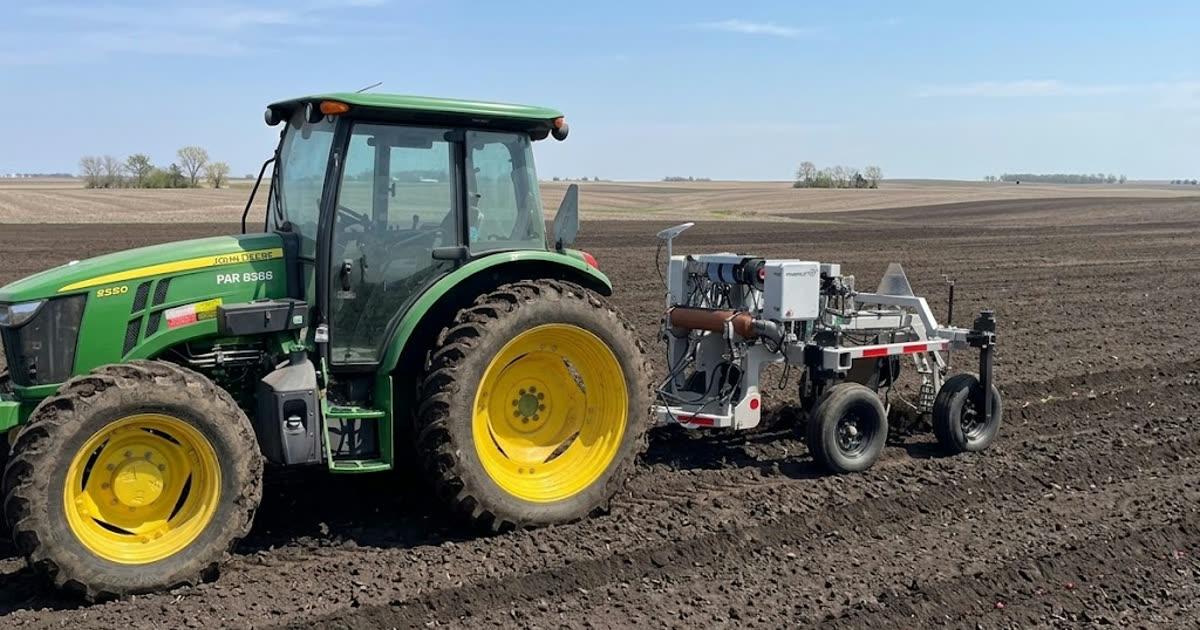
The Blaster 1000 is a towed implement that opens a shallow trench and measures soil fertility roughly twenty times per second as it moves, producing nutrient maps at a resolution of 0.15 acres, an 80-by-80-foot grid that matches the working width of application equipment already in the field. That is about 16 times finer than the 2.5-acre grid of conventional composite sampling, with results in seconds instead of days and each nutrient reported in six one-inch layers plus the standard zero-to-six-inch composite.
The company's own case study shows why resolution matters more than averages. Two measurements of the same field, at 2.5-acre and 0.15-acre grids, recommend the identical average potassium rate and the same total tonnage of 118 lbs per acre. But at the conventional resolution roughly 40% of the acres are mis-prescribed: 20% receive more potassium than they need and 20% receive too little. One 2.5-acre cell reading "Optimal" turns out to be 50% Low, 31% Optimal and 19% High.
TerraBlaster puts the economics at up to $45 per acre, combining roughly $10 per acre saved on soil lab and labour costs with about $35 per acre of yield gain at $5 corn and $12 soybeans; in the most deficient areas yield gains can reach 20%. The technology is based on Laser Induced Breakdown Spectroscopy, spearheaded by Dr Pablo Sobron, now a TerraBlaster board member, to analyse Martian soil for NASA.
Alongside the round, TerraBlaster opened an early-access programme: demonstrations with Midwest growers and retailers this autumn feed into systems delivered in spring 2027, with a pre-sale opening this fall and first-system commitments already in place. CEO Jorge Heraud co-founded Blue River Technology, acquired by John Deere in 2017; CTO Dr Matt Colgan was one of Blue River's early employees. The team of ten operates between Menlo Park and Iowa.
TerraBlaster, the Menlo Park precision-agriculture startup founded in 2024, has closed a $12.5 million seed round led by Ulu Ventures, bringing total capital raised to $16.5 million. Khosla Ventures, Trailhead Capital, Builders Vision and Bidra also participated, alongside Ag Startup Engine, Reservoir, Sunna, Plug and Play, GrainInnovate and the Hort Innovation Venture Fund managed by Artesian. Ulu Ventures partner Steve Reale joins the board.
The Blaster 1000 is a towed implement that opens a shallow trench and measures soil fertility roughly twenty times per second as it moves, producing nutrient maps at a resolution of 0.15 acres, an 80-by-80-foot grid that matches the working width of application equipment already in the field. That is about 16 times finer than the 2.5-acre grid of conventional composite sampling, with results in seconds instead of days and each nutrient reported in six one-inch layers plus the standard zero-to-six-inch composite.
The company's own case study shows why resolution matters more than averages. Two measurements of the same field, at 2.5-acre and 0.15-acre grids, recommend the identical average potassium rate and the same total tonnage of 118 lbs per acre. But at the conventional resolution roughly 40% of the acres are mis-prescribed: 20% receive more potassium than they need and 20% receive too little. One 2.5-acre cell reading "Optimal" turns out to be 50% Low, 31% Optimal and 19% High.
TerraBlaster puts the economics at up to $45 per acre, combining roughly $10 per acre saved on soil lab and labour costs with about $35 per acre of yield gain at $5 corn and $12 soybeans; in the most deficient areas yield gains can reach 20%. The technology is based on Laser Induced Breakdown Spectroscopy, spearheaded by Dr Pablo Sobron, now a TerraBlaster board member, to analyse Martian soil for NASA.
Alongside the round, TerraBlaster opened an early-access programme: demonstrations with Midwest growers and retailers this autumn feed into systems delivered in spring 2027, with a pre-sale opening this fall and first-system commitments already in place. CEO Jorge Heraud co-founded Blue River Technology, acquired by John Deere in 2017; CTO Dr Matt Colgan was one of Blue River's early employees. The team of ten operates between Menlo Park and Iowa.